NFPA 80 Compliance Checklist for Fire Door Hardware Assemblies
One unlisted hinge voids the whole assembly's fire rating.
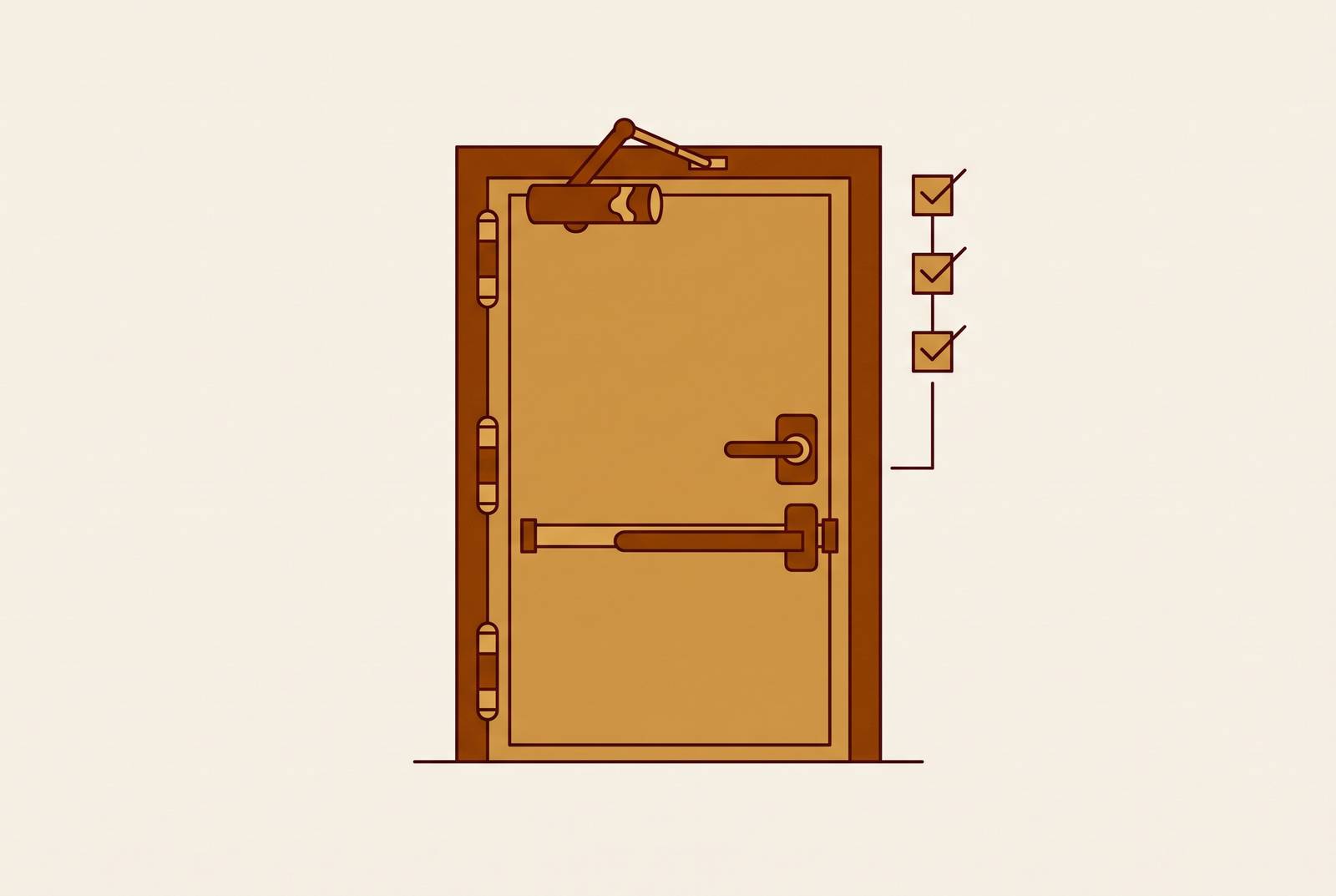
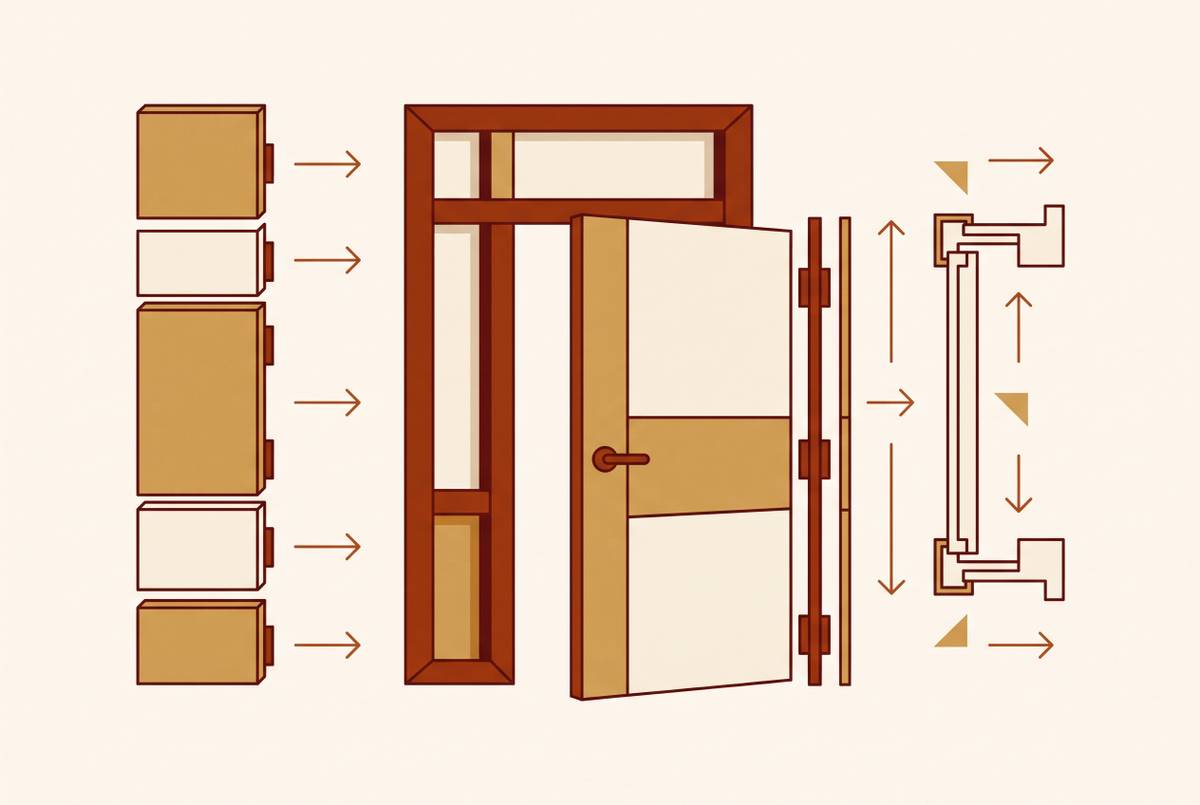
A fire door isn't one product. It's a leaf, a frame, hinges, a closer, latching hardware, and glazing, and every one of those pieces has to be listed and labeled by an approved testing lab. The assembly, taken as a whole, is what gets tested and certified. Estimators who price a fire door like a commodity item, the way you'd swap in a standard hollow metal door, are the ones who end up with a rejected opening at final inspection, and that habit is one of the most consequential estimating errors on Division 8 work. It is also entirely avoidable, which is what makes it worth calling out directly rather than treating it as one risk among many.
Hardware listings for hinges, closers, locksets, and exit devices live in the testing lab's directory, and they don't always show up as a physical stamp on the part itself. An inspector checking a job is verifying an approved type against that directory. Swap in one hinge that isn't listed for the assembly, and the whole opening's compliance is void, no matter how correctly everything else was installed.
Field cutting is where this gets expensive. Fire doors are tested as complete units, so any change the listing doesn't explicitly allow voids the rating. Some listings don't allow field cutting at all, and any trimming beyond what the listing explicitly permits voids the rating. Trimming a door to fit a rough opening beyond that allowance is a violation, full stop, and it's exactly the kind of thing an estimator should flag at takeoff, not discover after the door's already hung.
Labels have to stay legible and physically attached for the life of the assembly, per NFPA 80 §5.2.4. A door installed correctly in 2015 with a label that's since been painted over or scraped illegible is non-compliant today, regardless of how clean the original install was.
Glazing follows its own rules, tied to rating. Vision panels need fire-rated glazing, and on 3-hour doors that glazing can't exceed 100 square inches unless additional testing supports a larger opening. The glazing itself needs a permanent label identifying the lab, the rating, and whether it passed hose stream testing. A spec calling for a vision lite in a 3-hour door isn't automatically buildable, so confirm it before the bid goes out, not after.
Frame and rough opening preparation — what has to be right before the door goes in
The frame has to be listed for the rated assembly it's going into, and that listing has to match the door's fire rating. Hollow metal is the standard for most commercial fire-rated openings, and before the door ever gets hung, the frame has to be plumb, level, and free of warp or twist. That's both an inspection criterion under NFPA 80 and the baseline condition that makes every clearance tolerance downstream even achievable.
Hollow metal frames need to be properly filled and set per the listing requirements, and that applies to the full installation, not just the door leaf. Skip the grouting, and both the structural stability of the frame and the fire-resistive performance of the whole assembly take the hit.
No open holes or breaks in the frame are allowed. That's a standalone inspection point, and it covers weld splatter that never got cleaned up, cutouts made for electric strikes, and conduit penetrations that need to be properly sealed with approved materials.
Thresholds, where the assembly calls for one, have to be appropriate for the rated opening. A threshold that doesn't meet the assembly's requirements voids the whole thing.
Treating any of this as optional groundwork is one of the most avoidable mistakes on a Division 8 job, because frame condition at rough-in determines whether the clearances at final inspection are even achievable. A frame that's out of plumb, discovered only after hardware goes in, isn't a punch-list item. It's a rework cost, one that shows up because nobody checked the frame before the door went on it.
The 13 annual inspection points and what each one is actually checking
The 2022 edition expanded the annual inspection checklist from 11 items in prior editions to 13. The change split edge seals and signage into their own line items, reflecting how often those two things get overlooked in the field.
Inspection has to be visual, and it has to happen from both sides of the door. A walkthrough that only checks one face doesn't satisfy the standard, and it won't hold up if an AHJ ever asks to see the record.
Labels need to be visible and legible, not painted over or buried under hardware. There can't be open holes or breaks in the door or frame, whether from unauthorized penetrations or plain damage. Glazing, vision light frames, and glazing beads all need to be intact and fastened down; a cracked lite or a loose bead fails this one. The door, frame, hinges, and hardware all need to be secured, aligned, and working, with nothing missing or loose. Pull-side clearances between door edge and frame can't exceed the limits set in §6.3.1, covered in detail below.
The self-closing device has to close the door fully from a full-open position; a door that stalls partway fails. If the pair has a coordinator, the inactive leaf has to close before the active leaf, and that sequencing gets checked on its own. Latching hardware has to engage and hold the door shut without help, which rules out roller latches entirely. No auxiliary hardware can interfere with the door's operation, so wedges, rubber stops, and non-listed hold-opens are all violations on sight.
Edge seals, new to the list in 2022, need to be intact, with intumescent strips and smoke seals undamaged and seated correctly. Required signage, like a "Fire Door – Keep Closed" placard, needs to be present and legible on the correct side. There can't be field modifications that void the listing, and the door and frame need to still be plumb, level, and free of warp, since geometric drift is what quietly ruins clearances over time.
For contractors dealing with existing buildings, points 6, 7, 8, and 9, which cover closing, coordination, latching, and auxiliary hardware, are the most common operational failures. On new construction, points 2, 10, and 12, which cover open holes, damaged seals, and unauthorized modifications, are where installers most often get caught. That split isn't a coincidence: existing buildings fail on wear and neglect, new construction fails on shortcuts.
Clearance tolerances — the numbers that determine pass or fail
Estimates suggest somewhere between 50 and 80 percent of new rated openings fail their first inspection, and clearances are a leading reason for those failures. If there's one place to put scrutiny on a new installation, it's here, and treating clearance checks as a formality at rough-in is one of the most consequential mistakes a crew can make on a rated opening.
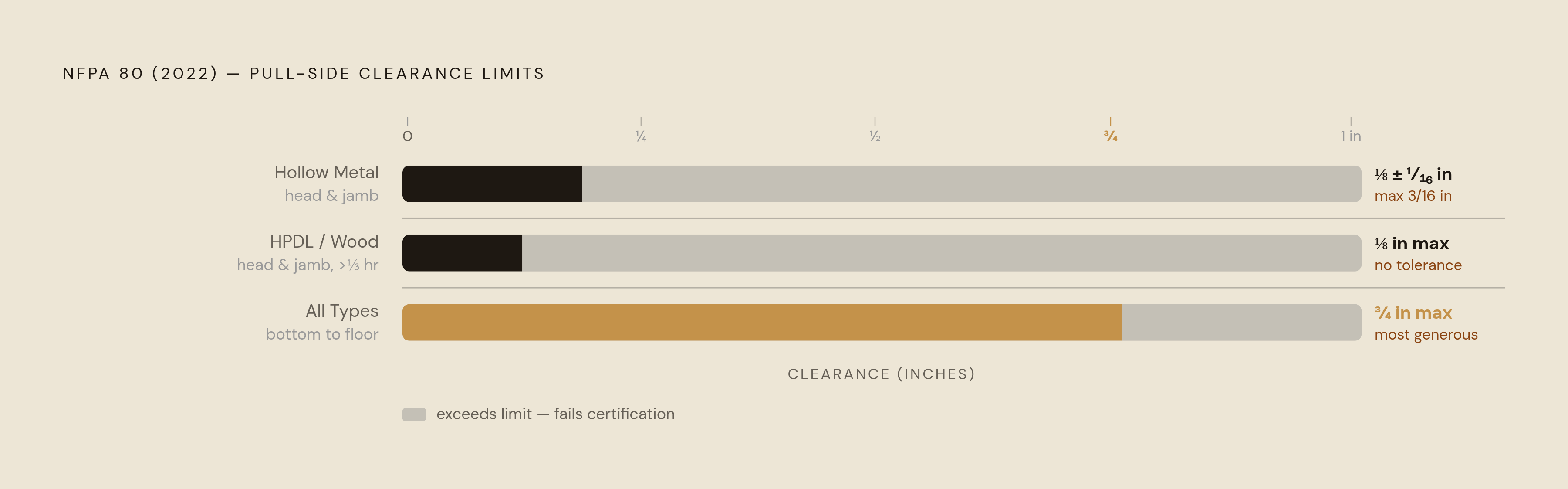
NFPA 80, in the 2022 edition, sets those clearances precisely, measured on the pull side. Hollow metal doors get head and jamb clearances of 1/8 inch, plus or minus 1/16 inch, maximum. HPDL-faced doors and stile-and-rail wood doors rated above 1/3 hour get a tighter 1/8 inch maximum at head and jamb, with no tolerance range at all. Meeting stiles on pairs follow the same limits as head and jamb, based on door type. Bottom clearance tops out at 3/4 inch, measured from the door's bottom edge to the top of the finished floor or threshold.
These numbers aren't arbitrary, and they are not up for site-level negotiation. They come straight from the fire test certification under UL 10C or NFPA 252, and a gap wider than what was tested lets flame or excessive heat through to the unexposed side, which means the assembly fails to do the one thing it was rated to do.
Clearances drift for a handful of predictable reasons: worn hinges, a door that's warped over the years, or a floor that's settled. Most of that is catchable at rough-in, if someone actually checks the frame before the door goes on it. Painting over intumescent seals deserves its own callout, because paint interferes with the material's listed performance, undermining the seal even when the dimensional gap measures within tolerance.
Roller latches deserve a specific mention here, because they keep showing up as the cause of failed inspections under point 8. They do not provide positive latching, and no fire door assembly should have them installed, regardless of what the original hardware set called for. Anyone who specs a roller latch on a rated opening is writing a failed inspection into the contract before the door's even ordered.
Hardware items that require individual verification — beyond the opening count
Every hardware item on a fire door needs its own listing check. A hinge or closer that's a perfectly good commercial product isn't automatically fire-door-rated; that has to be confirmed against the testing lab's directory, item by item.
Hinges need to be listed for the door's fire rating, and the configuration per leaf is itself a listing requirement, not a matter of installer preference. Improper hinging shows up later as both an operational problem and a clearance problem on doors that have been in service a while.
Self-closing is non-negotiable, and inspection point 6 exists specifically to check that the door closes fully from full-open, not partway. Hold-open closers and electromagnetic hold-opens have to be listed and installed per the assembly's requirements; a wedge or a rubber door stop used as a hold-open is an immediate violation, no gray area. On pairs with a coordinator, the inactive leaf has to close before the active leaf, and the coordinator itself needs to be verified as listed and functioning.
Latching hardware needs to engage the strike and hold the door shut without anyone pushing on it. Roller latches don't meet that bar and shouldn't be specified or installed on fire doors, ever. Exit devices need to be listed for use on fire door assemblies. Flush bolts on the inactive leaf of a pair need to be listed for the assembly.
Electrified hardware adds another layer. Electric strikes, mag locks, and electrified exit devices all need fire door listings, and any conduit run through the frame for that hardware has to be sealed with listed fillers; an unsealed penetration is an open-hole violation, the same as a stray cutout. A missed listing requirement caught after the bid is already awarded turns into a schedule problem, not just a paperwork one.
Edge seals and smoke seals round this out. They need to be listed for the specific assembly and installed exactly per the manufacturer's instructions, and they can never be painted over, for the same reason bottom seals can't: paint compresses intumescent material and kills its listed performance. Point 10 in the 2022 inspection checklist exists to catch exactly this at every annual inspection.
Documentation, records, and what the AHJ will ask to see
NFPA 80 requires an annual inspection and a signed, written record. That record needs the date, the inspector's name, and a disposition for each assembly: pass, fail, or corrective action required. Inspection records need to be kept for a minimum of three years unless the local AHJ asks for longer, and acceptance test records, the ones documenting how the assembly performed when it was first installed, need to be kept for the life of the assembly.
Deficiencies have to get fixed "without delay." Many AHJs read that as a 60-day window in practice, but that's a convention, not a guarantee: a fire marshal can require immediate correction or pull a certificate of occupancy if the situation warrants it.
The standard doesn't name a specific certification for who's allowed to do the inspection. It asks for a qualified person, someone with the knowledge, training, and experience to evaluate a fire door assembly properly. In practice, two credentials carry weight with AHJs and accreditation bodies: DHI's Certified Fire & Egress Door Assembly Inspector (CFDAI) and Intertek's Certified Fire Door Inspector (CFDI). An inspection performed by someone without either credential isn't automatically invalid, but it's the first thing an AHJ will question if a record gets challenged.
Inspection still has to happen from both sides of the door, since a single-side walkthrough doesn't meet the standard and won't survive scrutiny if an AHJ pulls the records. For contractors closing out a project, the acceptance test record is a separate document from the annual inspection record, and it needs to be kept for the life of the building, not just filed away until the next inspection cycle.
Healthcare and institutional projects — where the same checklist carries greater consequences
The checklist doesn't change in a hospital; what changes is what happens when an opening fails it. In an occupancy where patients can't self-evacuate, a fire door that won't self-close or won't positively latch isn't a deficiency waiting on a corrective action window. It's a smoke compartment that doesn't hold, in a building full of people who depend on that compartment holding.
CMS jurisdiction adds a second layer to this that has already come up: healthcare facilities follow the 2010 edition of NFPA 101, referenced through the CMS-mandated 2012 edition of NFPA 101, while the fire marshal down the street might be enforcing 2022. A CMS surveyor and a local AHJ can walk the same corridor and cite different editions of the same standard, and a facilities team that hasn't sorted out which edition governs which door is exposed on both fronts.
Documentation carries more weight here too. CMS surveys and Joint Commission accreditation reviews both draw on the same annual inspection records NFPA 80 requires, and a missing or incomplete record can affect a facility's accreditation status and, downstream of that, its Medicare and Medicaid reimbursement.
None of the 13 inspection points, the clearance numbers, or the hardware listing rules described above changes for a hospital corridor door versus a door in an office building. What changes is the cost of getting any one of them wrong, and that's precisely why healthcare facilities teams run fire door inspections more often, and more carefully, than the annual minimum requires.